Water-Absorbent Expansion Bag is a sand-free emergency flood control material, widely used to quickly build water barriers at doorways, power distribution rooms, garage entrances and pipe gaps. Its working logic differs fundamentally from traditional sandbags that rely on dead weight. Its water-stopping performance mainly comes from the super absorbent polymer (SAP) inside. When contacting water, SAP absorbs liquid and swells rapidly. Confined inside the bag, it generates expansion pressure, fills gaps and compacts adjacent bags to block seepage paths. The water-stop effect is a combination of polymer swelling sealing and stacking compression sealing, instead of simply relying on self-weight to hold back water. This article explains the underlying water-stop principle of Water-Absorbent Expansion Bag from six aspects: core material property, water absorption and swelling mechanism, compression sealing effect, gap plugging logic, failure causes and comparison with traditional sandbags, supporting product selection, construction and flood response planning.
1. Core Component: Water Absorption Property of Super Absorbent Polymer (SAP)
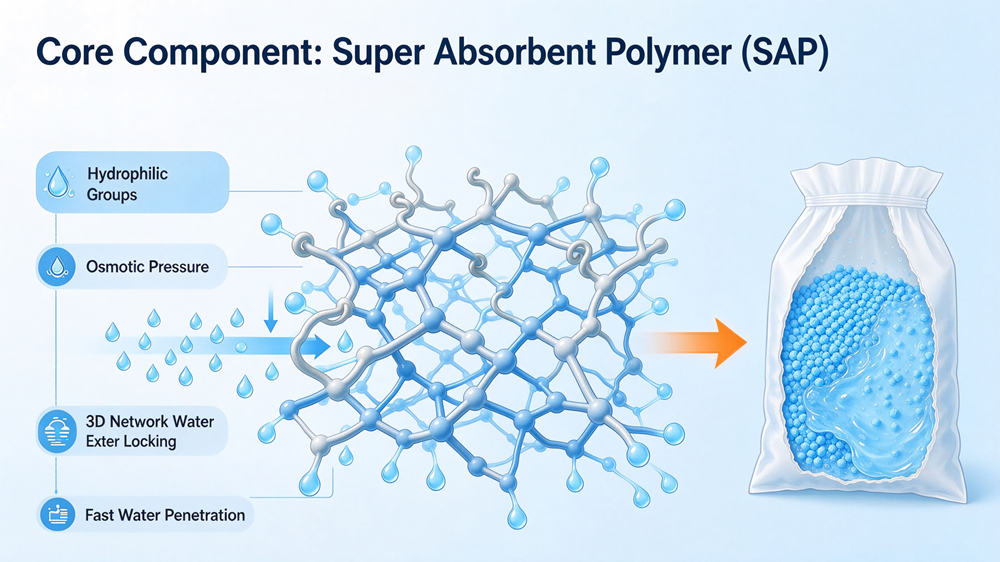
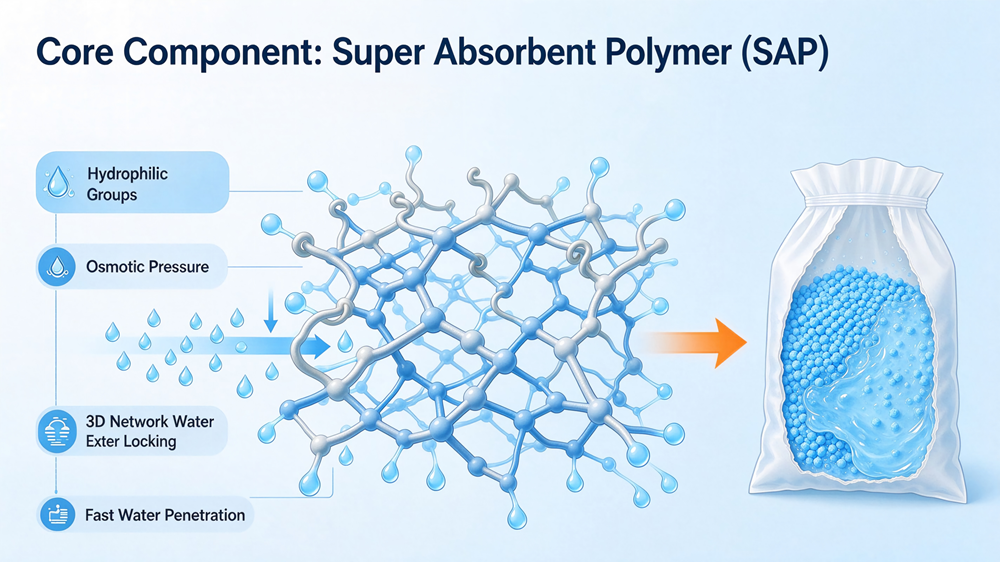
The functional core inside Water-Absorbent Expansion Bag is super absorbent polymer (SAP), a crosslinked polymer. Unlike sponges and fabrics that only store water via capillary action, SAP contains abundant hydrophilic groups on its molecular chains. When touching water, these groups bind water molecules. Driven by osmotic pressure, SAP continuously absorbs water and locks water molecules inside its 3D network structure to prevent free flow.
SAP can absorb tens to hundreds times its own weight of clean water, which is the foundation for Water-Absorbent Expansion Bag to expand and generate sealing pressure. The polymer is wrapped inside a non-woven composite bag, which restricts gel leakage while allowing fast water penetration.
2. Swelling Mechanism: Volume Expansion Driven by Osmotic Pressure
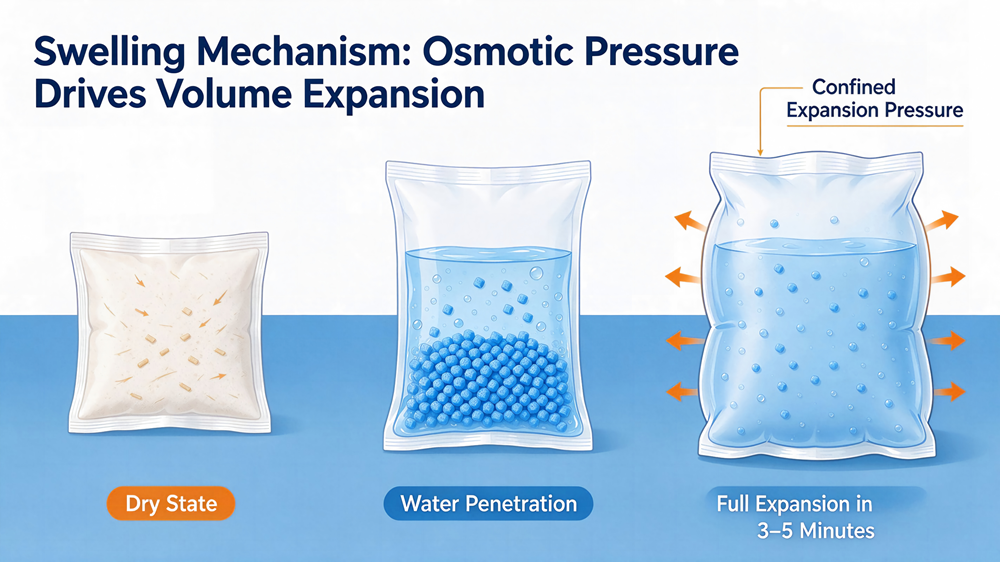
In dry condition, SAP molecular chains curl tightly. The Water-Absorbent Expansion Bag is compact and lightweight for easy storage and transport. Once clean water penetrates the bag and touches SAP, osmotic balance breaks. Water molecules enter the polymer network and stretch curled chains, so the bag expands rapidly and reaches saturation within 3–5 minutes.
This swelling is not just water filling. Water is stored inside the polymer network. Confined by the outer bag, unlimited outward expansion is blocked, and swelling force converts into static outward pressure. This expansion pressure is the key power for Water-Absorbent Expansion Bag to achieve water sealing.
3. Stacking Compression Sealing: Interlocking Bags to Block Seepage Paths
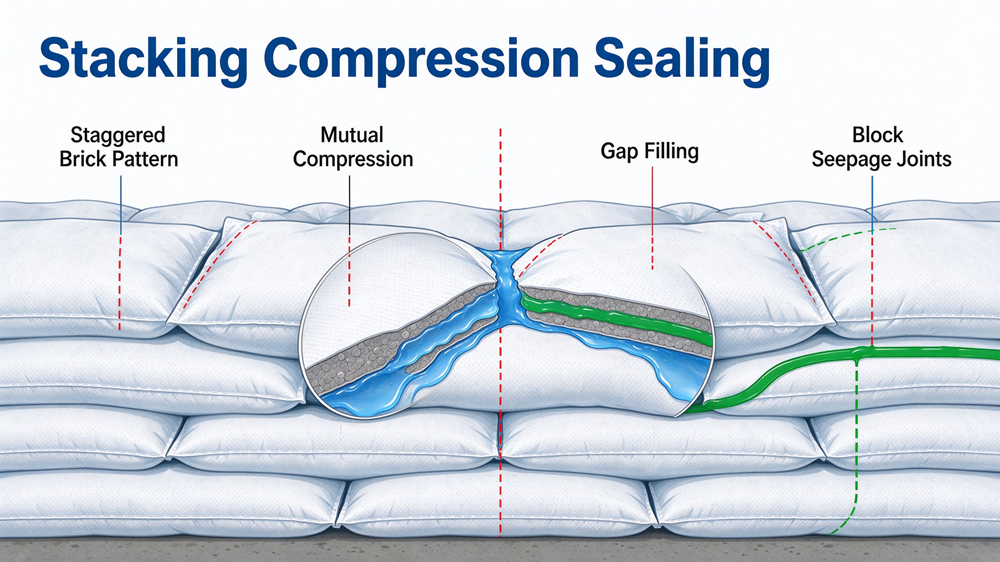
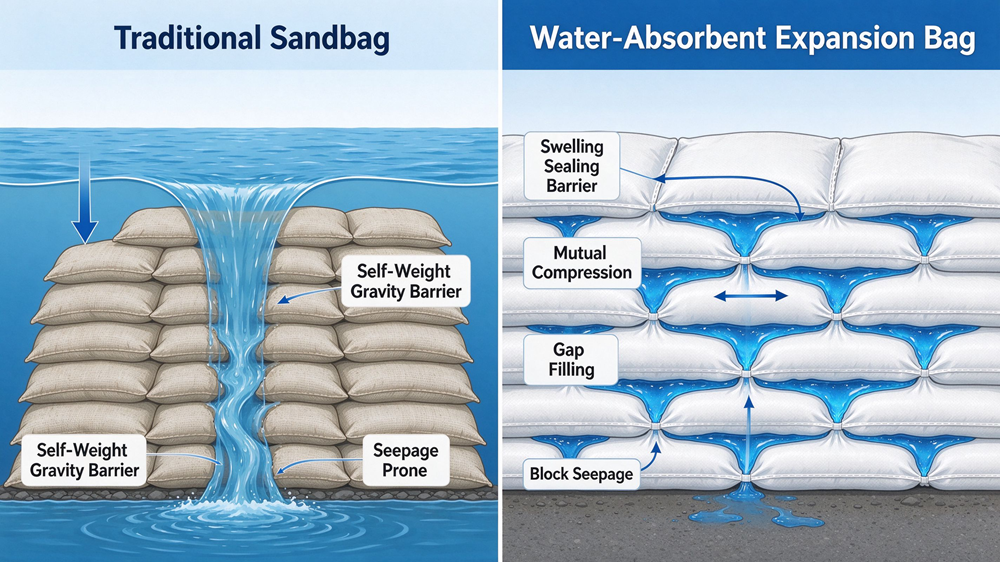
A single Water-Absorbent Expansion Bag can plug local gaps, but continuous flood barriers rely on staggered stacking and compression sealing. Fully expanded bags are flexible and slightly deformable. When laid in staggered courses, adjacent bags press against each other. Tiny gaps between bags are filled by expansion pressure.
Traditional sandbags are compacted by sand weight and naturally contain many gaps with long seepage paths. Expanded Water-Absorbent Expansion Bags are self-adaptive. They fit irregular surfaces and adjacent bags, compress and fill gaps, and block seepage along joints. This explains why staggered stacking is required and straight aligned seams are forbidden.
4. Interface Sealing Principle: Fitting Substrate and Blocking Bottom Gaps
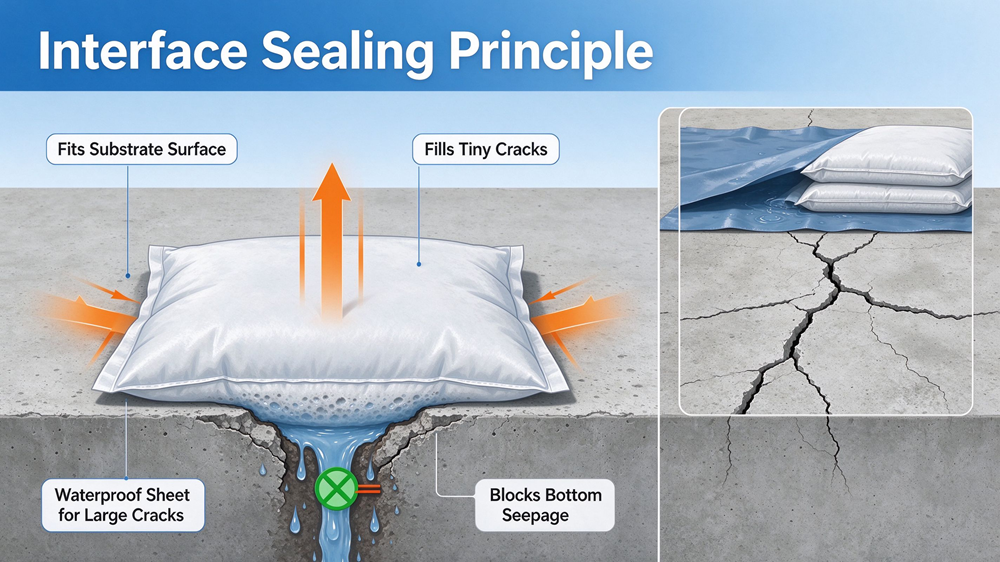
The most common leakage point of a barrier is the bottom interface between bags and ground. After swelling, Water-Absorbent Expansion Bag generates lateral and vertical pressure to fit concrete floors, thresholds and other substrates, filling tiny cracks and pits on the ground.
For heavily cracked ground, the adaptive deformation of Water-Absorbent Expansion Bag cannot bridge large voids. A waterproof sheet should be laid first to block major leakage paths before stacking expansion bags. The sealing function works only for narrow gaps instead of large cavities.
5. Key Limiting Factors That Weaken Water-Stop Performance
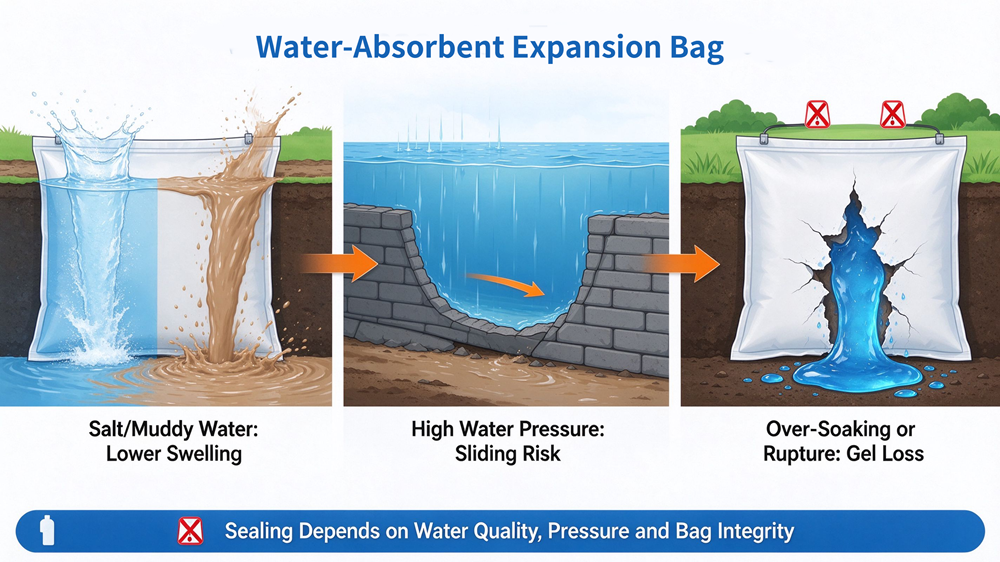
The water-stop performance of Water-Absorbent Expansion Bag is sensitive to water quality. Salt water and muddy water reduce osmotic pressure, cut SAP absorption capacity and weaken expansion sealing force. That is why combining with traditional sandbags is recommended for salty or muddy floodwater.
Besides, expansion pressure has an upper limit and cannot resist ultra-high water pressure. Excessive water level may cause sliding or collapse of the whole barrier. Over-soaking or bag rupture with gel leakage will destroy its sealing function directly. The water-stop logic of Water-Absorbent Expansion Bag depends on swelling compression; once gel leaks out, sealing fails.
6. Principle Comparison: Core Difference from Traditional Sandbags
Traditional sandbags: they work as gravity barriers relying on the dead weight of sand and gravel. Gaps are unavoidable and seepage is normal, suitable for slow water retention.
Water-Absorbent Expansion Bag: its core is sealing pressure generated by polymer water absorption and swelling. It has low dead weight. It does not hold back water by weight, but fills gaps and cuts seepage paths through mutual compression after expansion. It features fast deployment and easy storage. Its limitation is that sealing performance is restricted by water quality, water pressure and bag integrity. It is designed for emergency, short-term flood plugging under medium and low water levels.
Conclusion
In short, the basic water-stop principle of Water-Absorbent Expansion Bag: the internal SAP absorbs water under osmotic pressure. The polymer network stretches and expands. Confined by the outer bag, volume expansion converts into sealing pressure. With staggered stacking, adjacent bags and the bag-ground interface are tightly compressed, filling tiny gaps and blocking seepage. It is a swelling sealing flood control material, different from gravity-type sandbags that rely on dead weight. Reliable water retention requires proper soaking time, intact bags, avoidance of salty and muddy water, and standard staggered stacking to fully activate the swelling compression sealing mechanism.
We use cookies to offer you a better browsing experience, analyze site traffic and personalize content. By using this site, you agree to our use of cookies. Privacy Policy